What makes Rust a solo survival challenge worth watching in Blooprint's Apex Survivor?
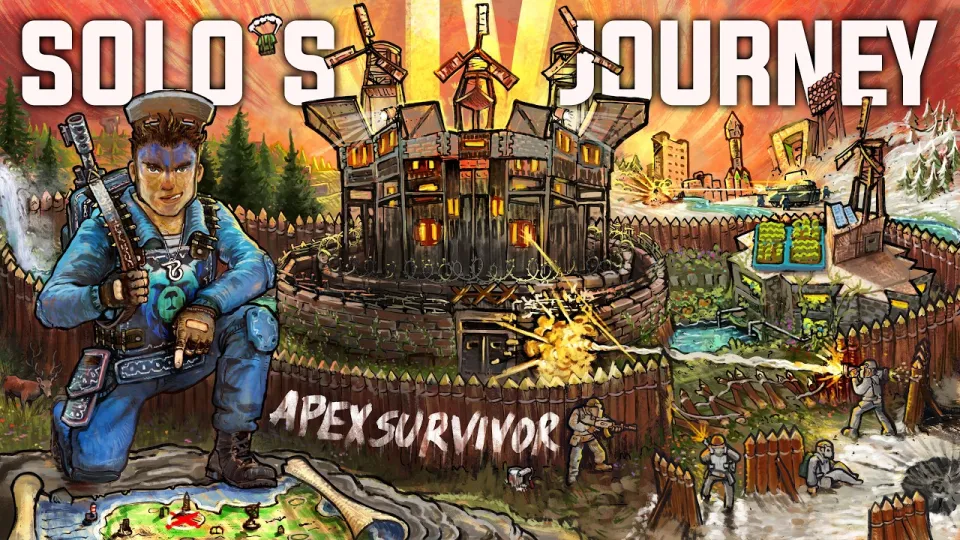
Video: Rust - A Solo's Journey IV: Apex Survivor (Movie)
Want articles like this for your own video to promote it on YouTube and Google? Order them through the Telegram bot @sat_sit_bot. Articles with your video embedded are written and posted by the bot itself — on popular topical sites (no ads). Try it free: 50 articles on us.
· based on the channel Blooprint
Key takeaways
- Blooprint survived 14 real days of solo Rust and edited the run into a single movie of roughly 4 hours 50 minutes.
- The film is cut into 12 numbered chapters plus an intro and an ending, with chapter timestamps listed in the description.
- A companion site at solosjourneytracker.com lets viewers enter a timestamp and see the creator's progress at that exact moment.
- The video marks 2.5 million subscribers on the channel, with limited merch tied to the milestone.
- Solo Rust means one player handling farming, base building, crafting, PvP and raids without a clan to split the work.
Rust is a hardcore multiplayer survival game where one player can absolutely survive alone, but doing it for a full wipe takes planning, patience and a lot of hours. Blooprint's movie "A Solo's Journey IV: Apex Survivor" documents exactly that: 14 days of solo Rust compressed into a single feature-length watch. The companion progress tracker lets you type in any timestamp and see what the creator's base, gear and goals looked like at that moment, which makes the run far easier to follow than a raw gameplay dump.
What is Rust and why is solo play considered the hard mode
Rust drops players onto a persistent server where everything you own can be taken by other players, and solo play removes every safety net a group provides. A clan can split duties — one member farms scrap, another runs monuments, a third guards the base — while a solo player has to do all of it while leaving the base undefended. That is why solo runs are measured in days rather than hours: progress is slow, losses are permanent, and every decision about where to build and what to carry matters. The game's core loop of gather, craft, build, fight and raid never changes, but a solo player feels every step of it personally.
How the Apex Survivor movie is structured
The film is built as a chaptered story rather than a highlight reel, which is what separates it from standard Rust gameplay uploads. The description lays out twelve numbered chapters plus an introduction and an ending, and the whole thing runs just under five hours. Each chapter follows a phase of the run — early spawn and first base, mid-game expansion, and the later fights over resources and territory. Because the chapters are listed with timestamps, viewers can jump straight to a specific stage, and the tracker site fills in the context that a five-hour runtime would otherwise bury.
What a solo Rust run actually demands day by day
Surviving alone in Rust is a routine of small, repeatable tasks done under constant risk, and the 14-day format shows how that routine compounds. The pattern looks roughly like this:
- Secure a starter base near resources but away from obvious traffic, and keep it cheap enough to lose.
- Farm scrap and components to unlock workbenches, weapons and building upgrades.
- Run monuments and events for loot while accepting that every trip out is a gamble.
- Expand into a stronger base with layered doors, and split stored loot so one raid does not end the run.
- Push into PvP and raiding once gear and explosives are reliable.
What makes the format interesting is that none of these steps are guaranteed. A single bad fight or an overnight raid can erase days of progress, and the movie's length reflects how much of solo Rust is recovery as much as advancement.
How base design and farming decide a solo wipe
Base design is the difference between a run that lasts two days and one that lasts two weeks, and the film spends real time on it. A solo player cannot rely on numbers, so the base has to do the work: multiple layers between the outside and the loot, doors that force raiders to spend explosives, and a layout that hides what is actually valuable. Farming is the other half — stone, wood, metal and scrap all feed directly into how fast the base grows and how quickly gear improves. Comments from viewers single out the farming base and the cloning setup as highlights, which tracks with how solo Rust works: efficient production beats flashy plays over a long wipe.
PvP, raids and the social side of a solo server
Solo Rust is not a single-player game, and the movie leans into the politics and grudges that build up over two weeks. Neighbours, alliances and revenge raids all shape the run, and viewers responded strongly to moments where rival groups got what was coming to them. That social layer is a big part of why the format works as entertainment: a solo player is outnumbered, so every fight is a story about positioning, timing and knowing when not to engage. Long-running servers also produce recurring characters, and the film treats those encounters as plot rather than noise.
Common questions about long solo Rust runs
Viewers of long-format Rust content tend to raise the same practical doubts, and they are worth answering directly. The first is time: a 14-day run is not 14 days of continuous play, but a series of sessions spread across a wipe, with the boring parts cut and the decisive ones kept. The second is editing — hundreds of hours of filming and editing went into this movie, which is why it holds together as a narrative instead of a raw stream. The third is whether the run is staged; solo Rust content is played on live servers where other players act independently, and the friction that creates is the point. The fourth is where to start watching: the chapter list and the tracker site exist precisely so a five-hour video does not have to be watched in one sitting.
Useful links
- Solo's Journey progress tracker — enter a timestamp to see the run's state at that moment.
- Blooprint vinyl figure on Youtooz — limited 2.5M subscriber merch.
- Blooprint mousepads and playmats at Epic Desk — second limited merch drop.
- Hires Studio — animated intro work.
- Veys — thumbnail art.
Final thoughts on Apex Survivor
Apex Survivor works because it treats solo Rust as a survival story rather than a kill compilation, and the chapter structure plus the tracker site make a five-hour runtime approachable. The run shows the real cost of playing alone: every base upgrade, every farm run and every fight is done without backup, and losses hit harder because of it. Blooprint, the channel behind the movie, has built a reputation on exactly this kind of long-form storytelling, and the 14-day format is the clearest expression of it so far. If you want to follow along or check progress at any point, start with the Solo's Journey tracker and then dive into the chapters.
Questions & answers
Is Rust actually playable solo, or do you need a group?
Rust is fully playable solo, but it is significantly harder than group play. A solo player handles farming, crafting, base defence and PvP alone, so progress is slower and every loss is permanent. Long solo runs like the 14-day one in Apex Survivor are possible because the player plans around those limits instead of fighting them.
How long does it take to watch the whole Apex Survivor movie?
The video runs just under five hours, split into twelve numbered chapters plus an introduction and an ending. The description lists timestamps for each chapter, so it can be watched in parts. The companion tracker site lets you enter a timestamp and see the run's progress at that exact point.
What is the Solo's Journey tracker website for?
It is a purpose-built site for this video. You type in a timestamp from the movie and it shows the creator's base, gear and objectives at that moment, which helps when watching across multiple sessions. It is the easiest way to keep track of a run that spans 14 in-game days.
Why do solo Rust videos get edited into multi-hour movies?
A long wipe produces far more footage than a normal upload, and the interesting parts are spread across days of farming and building. Editing condenses the downtime and keeps the decisive fights, raids and base moments. In this case the creator reports spending well over 300 hours filming and editing the project.
Source: Rust - A Solo's Journey IV: Apex Survivor (Movie) · Markdown version